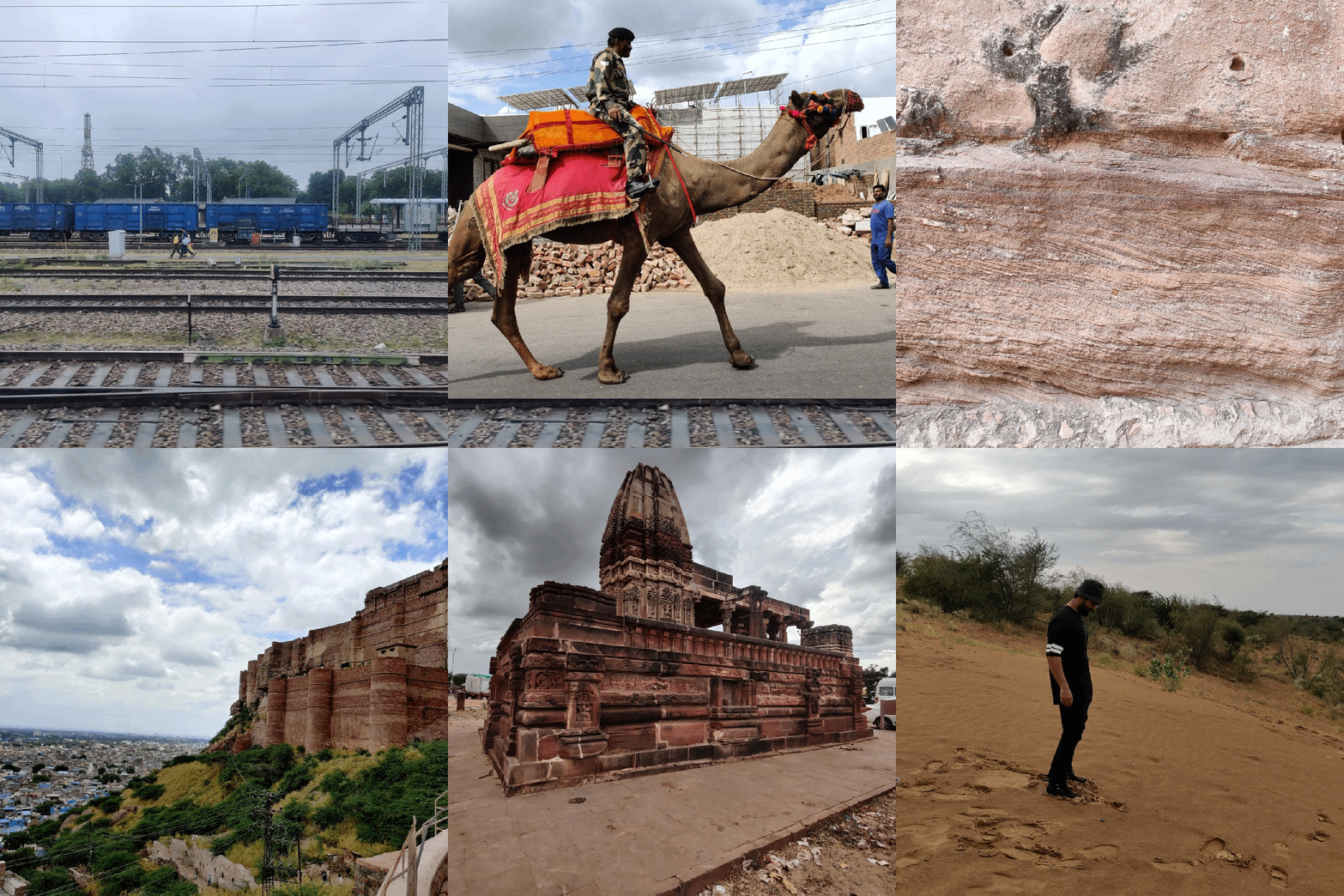
A Greek poet C.P. Cavafy wrote a poem titled “Ithaka.” It is considered to be one of his most well-known compositions and is frequently included in collections of his writing. This poem is a reflection on the journey of life and the ultimate objective of arriving at one’s home (a final destination), which is referred to in the poem as “Ithaka.” Instead; concentrating entirely on the final destination, the poem advises the reader to take pleasure in the trip itself and be grateful for the opportunities that present themselves along the route.
The Poem
–By C. P. Cavafy, “The City” from C.P. Cavafy: Collected Poems. Translated by Edmund Keeley and Philip Sherrard.
As you set out for Ithaka
hope your road is a long one,
full of adventure, full of discovery.
Laistrygonians, Cyclops,
angry Poseidon—don’t be afraid of them:
you’ll never find things like that on your way
as long as you keep your thoughts raised high,
as long as a rare excitement
stirs your spirit and your body.
Laistrygonians, Cyclops,
wild Poseidon—you won’t encounter them
unless you bring them along inside your soul,
unless your soul sets them up in front of you.
Hope your road is a long one.
May there be many summer mornings when,
with what pleasure, what joy,
you enter harbours you’re seeing for the first time;
may you stop at Phoenician trading stations
to buy fine things,
mother of pearl and coral, amber and ebony,
sensual perfume of every kind—
as many sensual perfumes as you can;
and may you visit many Egyptian cities
to learn and go on learning from their scholars.
Keep Ithaka always in your mind.
Arriving there is what you’re destined for.
But don’t hurry the journey at all.
Better if it lasts for years,
so you’re old by the time you reach the island,
wealthy with all you’ve gained on the way,
not expecting Ithaka to make you rich.
Ithaka gave you the marvellous journey.
Without her you wouldn’t have set out.
She has nothing left to give you now.
And if you find her poor, Ithaka won’t have fooled you.
Wise as you will have become, so full of experience,
you’ll have understood by then what these Ithakas mean.
The poem’s opening line encourages the reader to have high hopes for a lengthy voyage, one that is filled with exciting new experiences and potential discoveries to be unfolded enroute. The traveller (it is us to who the writer is addressing as a traveller) is cautioned not to be terrified of the obstacles that may appear during their journey (is is the life in its entirety addressed as a journey, by Cavafy), for instance the Laistrygonians (Greek mythology- a man eating gaiant), the Cyclops, and a furious Poseidon (all metaphors for the obstacles one might face on his endavours for a satisfied life). Cavafy is reminding the reader that these hurdles will only be encountered if they are carried within the soul, and that these challenges can be overcome by keeping thinking elevated and preserving a sense of joy and wonder in spite of the difficulty of the situation (it is us who hold on to the things which are not ment to be carried, it is us who thries to define and catogorize all our experiences; rather than just experiencing them).
Cavafy then goes on to discuss the joys of the voyage (the life), advising the traveller to relish the pleasures of new and unfamiliar locales (the writer suggest the reader to experience, enjoy and elevate from the unknown). Cavafy’s description of the joys of the journey may be found here, in the unknowing of what awaits us around the corner. The visitor is strongly encouraged to make a pit stop at Phoenician trading stations (maratime traders community 1500-300 B.C) in order to purchase exquisite items and to travel to Egyptian towns in order to acquire knowledge from the local experts.
This visual of Egypt as the distant land rooted in history serves to drive home the point that the voyage itself transcends time, as does the concept that the wisdom gained along the path is timeless.
Despite the fact that these side trips are enjoyable, the traveller should always keep Ithaka (home), the final objective, in the back of their mind at all times. According to the poem, getting to Ithaka is the prime objective, but one should not try to achieve it too quickly (getting home or to a desired destination is the prime objective; but in doing so we should also fully experience, relish and enjoy the detoures. It is these detours that make us wealthy by knowledge, happy by soul and wiser by temperament). Instead, one should make the most of the trip and have patience even if it takes many years to get to their final objective, the home.
The journey itself should be enjoyed. This is due to the fact that the trip itself is the real treasure, and the traveller ought to come away from the trip richer thanks to the experiences and insights obtained along the way.
Ithaka is not the final destination, but rather the departure place for the journey, as the poem draws to a close by highlighting this point (for all its value as an endpoint, the journey itself is the prize that we as a traveller seek for).
The Ultimate Purpose??? What actually is Ithaka???
Ithaka has already provided the traveller with the “marvellous journey,” therefore she has nothing else to offer in the final stage. Even if the traveller arrives in Ithaka (the final resting place for onself) and finds it to be a disappointing and unsatisfying or not what he had expected, the journey will have been worthwhile because it will have helped the traveller become more knowledgeable, wise and experienced. Additionally, the traveller will have gained an understanding of the genuine significance of the journey as well as the ultimate purpose of life.
In a nutshell, “Ithaka,” by C.P. Cavafy, is an insightful and beautiful metaphor, which explores into the human experience of travelling through life, location by location. The poem encourages the reader to cherish the experiences they have and the lessons they have learned along the way rather than solely focusing on getting to their destination in a rushed inattentive manner. It also encourages the reader to appreciate the journey itself, rather than focusing solely on the destination.
The poem is a meditation on the ephemeral quality of the journey, the value of perseverance and perspective, and the comprehension of the ultimate reality regarding the relevance of life’s meaning.
To all my readers, I pray for you good health, a happy spirit, and a fulfilling existence.


Leave a comment