Unravelling Motivation: Through the Lens of Maslow’s Hierarchy of Needs
Motivation is the engine that drives us forward, propelling us to action and pushing us beyond our comfort zones. But what exactly fuels this drive? Apart from the Dopamine high! Why do we pursue certain goals or tasks with fervour while others barely register on our radar? To take a deep dribve into this phenomenon, we turn to the concept of motivation and explore its roots in the ground-breaking work of humanistic psychology.
Understanding Motivation:
At its core, motivation is a fusion of motive and action, rooted in the Latin word movere, meaning “to move.” It encompasses the forces that energize and direct our behaviour towards achieving a particular goal or fulfilling a specific need.
But what are these driving forces, and how do they manifest in our everyday lives?
Enter Abraham Maslow, a pioneer in the field of psychology, who proposed a revolutionary theory known as Maslow’s Hierarchy of Needs in 1943. “This conceptual framework aimed to unravel the intricacies of human motivation by delineating a hierarchical structure of needs that drive our behaviour”.
Maslow’s hierarchy resembles a pyramid, with each level representing a distinct category of needs that must be fulfilled before progressing to the next. At the base lie our fundamental physiological needs, followed by safety, love and belongingness, esteem, and finally, self-actualization as we move up the triangle.
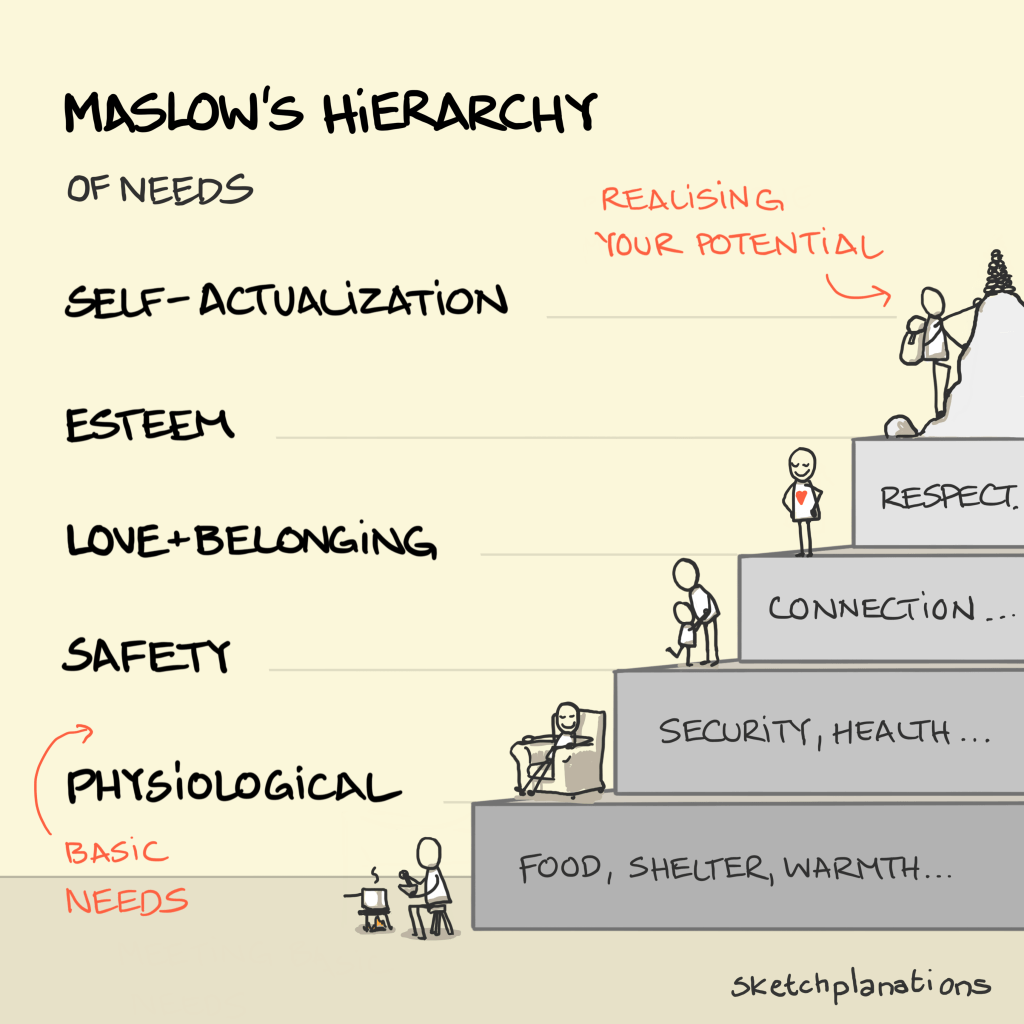
The above image is the work of Jono Hey borrowed from his website:- https://sketchplanations.com do check him out.
Here let’s try and understand Marslow’s Hierarchy of Needs by an example of a critically acclaimed movie “Cast Away,” the protagonist, Chuck Noland, finds himself stranded on a deserted island, where he is forced to make crucial survival decisions. By examining Chuck’s choices in the film, we can draw parallels between his journey and Maslow’s Hierarchy of Needs.
5. Physiological Needs
Upon finding himself marooned on a deserted island, Chuck’s immediate focus is on survival. He scours the island for food, water and shelter. These actions mirror Maslow’s foundational level of physiological needs, highlighting the instinctual drive for survival.
4. Safety Needs
Once Chuck secures these basic necessities, his attention shifts to ensuring his safety and security. He fortifies his shelter, learns to fend off wild animals, and navigates the treacherous terrain of the island. Chuck’s actions reflect Maslow’s second tier of safety needs, demonstrating his innate desire for security and stability as a motivation for his behaviour.
3. Love and Belongingness Needs
As days turn into weeks, Chuck grapples with profound loneliness and isolation. His makeshift companion, Wilson the volleyball, symbolizes his innate longing for human connection and companionship. Despite Wilson’s inanimate nature, Chuck’s bond with him fulfils his need for belongingness and highlights the power of social connections in motivating behaviour echoing Maslow’s third tier of love and belongingness needs.
2. Esteem Needs
As Chuck adapts to life on the island, he discovers newfound capabilities and resilience. He learns to fashion tools, build fires, and overcome daunting challenges, bolstering his sense of competence and self-worth. Chuck’s journey reflects Maslow’s fourth tier of esteem needs, as he strives for self-confidence, mastery, and recognition of his achievements.
1. Self-Actualization Needs
Ultimately, Chuck’s odyssey culminates in a profound journey of self-discovery and self-actualization. Through adversity and introspection, he taps into untapped reservoirs of strength and resilience, transcending his limitations and redefining his priorities. Chuck’s journey towards self-actualization culminates in a deeper understanding of himself and his place in the world, aligning with Maslow’s highest tier of self-actualization needs.
In “Cast Away,” Chuck’s progression through Maslow’s Hierarchy of Needs serves as a compelling narrative of human resilience, adaptability, and the pursuit of fulfillment. By paralleling Chuck’s journey with Maslow’s theory, we gain a deeper appreciation for the universal quest for meaning, purpose, and self-actualization inherent in the human experience.
Limitations of Maslow’s Hierarchy of Needs
Critics highlight its rigid hierarchical structure, which oversimplifies human motivation and disregards the dynamic interplay of various needs. Moreover, the theory’s Western-centric foundation raises concerns about its universal applicability across diverse cultural contexts.
While Maslow’s model of motivation has its limitations, it still offers valuable insights that can be applied to various contexts to enhance understanding and improve motivation. Here’s how we can make the best of Maslow’s model.
- Recognize Individual Needs:
- Understanding that individuals have unique needs and motivations. Using Maslow’s model as a framework to identify and address these needs, recognizing that different people may prioritize different levels of the hierarchy at any given time.
- Example: In a workplace setting, managers can use Maslow’s model to tailor their motivational strategies to individual employees. For instance, some employees may be primarily motivated by job security (safety needs), while others may seek recognition and opportunities for advancement (esteem needs).
- Create a Supportive Environment:
- Fostering an environment that supports the fulfilment of employees’ basic needs, such as providing fair compensation, ensuring physical safety, and offering opportunities for professional development.
- Example: A company can implement policies that promote work-life balance, provide access to healthcare benefits, and offer training and career advancement opportunities to address employees’ physiological and safety needs.
- Promote Social Connections:
- Recognizing the importance of social connections and belongingness in motivating individuals. Encouraging teamwork, collaboration, and camaraderie to create a sense of community and support.
- Example: Organizing team-building activities, fostering open communication channels, and celebrating milestones together can strengthen social bonds and fulfill employees’ needs for belongingness and love.
- Encourage Recognition and Growth:
- Acknowledging employees’ contributions and achievements to boost their self-esteem and sense of accomplishment. Provideing opportunities for skill development, feedback, and career advancement to support their growth and development.
- Example: Implementing employee recognition programs, conducting regular performance reviews, and offering training and development initiatives can help satisfy employees’ esteem needs and promote self-actualization.
- Facilitate Meaningful Work:
- Helping employees find purpose and meaning in their work by aligning their roles and responsibilities with their values and aspirations. Foster a sense of autonomy, creativity, and purpose in their tasks.
- Example: Providing opportunities for employees to contribute to meaningful projects, involving them in decision-making processes, and allowing flexibility in how tasks are performed can enhance their sense of purpose and fulfilment.
By leveraging Maslow’s model in these ways, organizations and individuals can better understand and address the diverse needs and motivations of people, ultimately leading to improved satisfaction, engagement, and performance. While Maslow’s model may not be perfect, it still offers valuable insights that can be applied effectively in various settings to enhance motivation and well-being.


Leave a comment