
How our focus shapes your mind: The science of near-sighted thinking and how to broaden your perspective.
In the world today, the act of staring at screens—whether it’s a phone, tablet, or computer—has become our second nature. As technology offers incredible convenience, there are cognitive implications that may be limiting the way we process information. Scientific studies suggest that prolonged focus on near objects, like mobile screens, narrows our thinking, fostering reactive and short-term decision-making. By contrast, viewing distant landscapes or engaging in introspective practices like journaling can expand our cognitive horizons and encourage abstract, long-term thinking.
How Screens Shape Myopic Thinking
Our brains are highly adaptive and fluid. Focusing on near objects for extended periods, such as scrolling on a screens, our visual and cognitive systems become attuned to immediate, bite-sized pieces of information. This phenomenon can create a “myopic” mental state—not just in the literal sense of affecting our eyesight, but also in the way we process information.
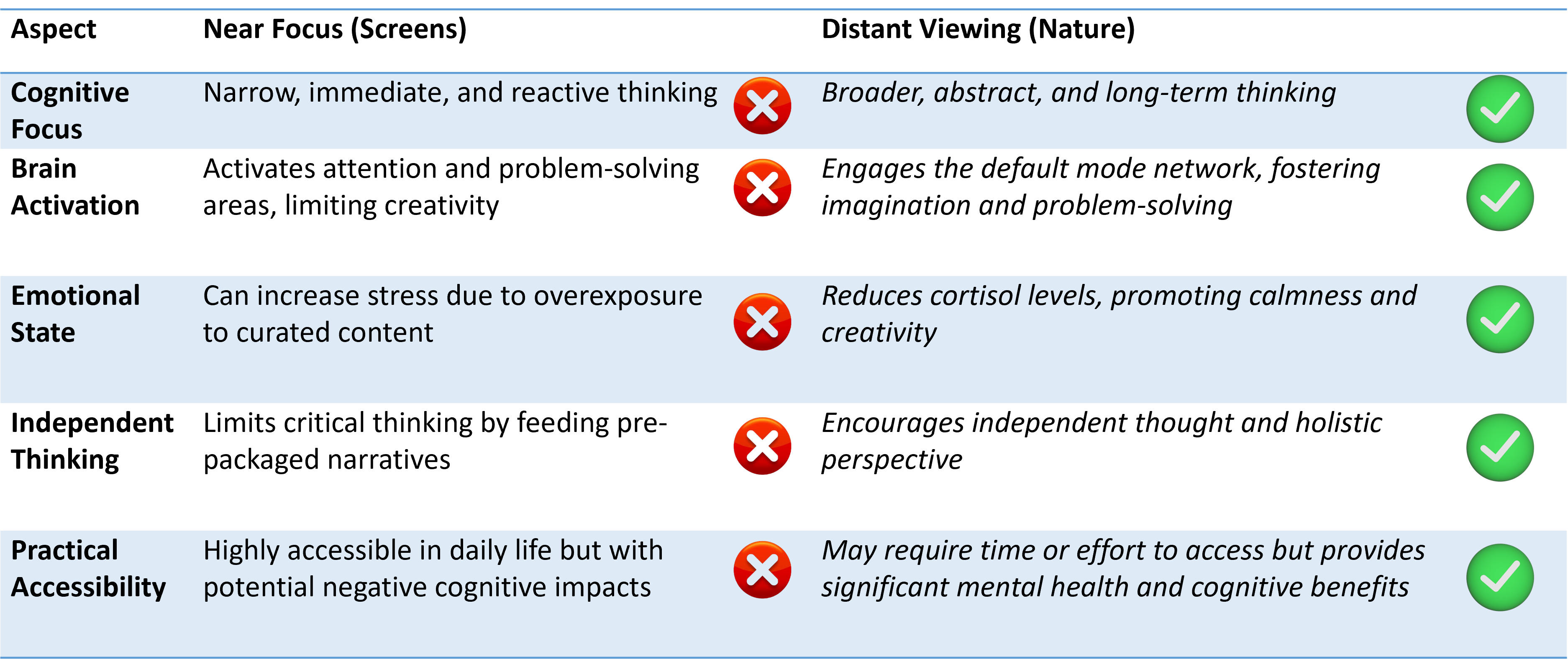
Near-sighted tasks primarily activate parts of the brain linked to immediate attention and problem-solving.
However, this focus often comes at the expense of engaging areas involved in creativity and abstract thinking. Over time, constantly consuming curated content trains our brains to prioritize quick responses over deeper, reflective processing, leaving us more reactive than proactive.
Digital content also feeds us pre-packaged narratives, which can stifle independent thought. Instead of analyzing or forming our own opinions, we often passively absorb the perspectives presented to us. This reduces cognitive flexibility and limits our ability to think critically or innovate.
Expanding Horizons: The Power of Distance
“In every walk with nature, one receives far more than he seeks.” – John Muir
Just as near-focused tasks narrow our perspective, viewing distant scenes—like a scenic hike or a sprawling skyline—can enhance cognitive function. Research in neuroscience and psychology shows that distant viewing encourages a state known as “mental decoupling,” where the mind shifts from immediate concerns to broader, abstract considerations.
When we gaze at expansive views, our brain’s default mode network becomes active. This system is associated with imagination, problem-solving, and long-term planning.
Observing vast landscapes also helps shift focus from the “here and now” to the bigger picture, fostering a more holistic mindset. Additionally, the calming effect of nature reduces cortisol levels, creating a mental state conducive to deeper thinking and creativity.
A Comparison: Near Focus vs. Distant Viewing
When Nature Isn’t an Option: The Role of Journaling?
“Writing is thinking on paper.” – William Zinsser
While spending time in nature is ideal, it’s not always feasible in daily life. Journaling offers an accessible and effective alternative to promote introspection and cognitive growth.
Writing allows us to simulate the mental decoupling that occurs in expansive environments, fostering critical and analytical thinking.
Journaling provides a space to question, analyze, and explore thoughts beyond surface-level reactions. By putting ideas on paper, we connect dots between seemingly unrelated concepts, encouraging deeper understanding and innovation.
Reflective writing also aligns our daily actions with larger goals, ensuring we remain focused on what truly matters.
The act of journaling mirrors the cognitive benefits of distant viewing by shifting our perspective. It encourages us to step back from immediate concerns and delve into broader, more abstract considerations. This practice can be particularly valuable in a world where near-sighted focus dominates our daily routines.
Practical Strategies I use to Broaden Perspective
“Almost everything will work again if you unplug it for a few minutes, including you.” – Anne Lamott
Incorporating practices that counte-balance the effects of near-sighted focus are not that complicated. Small, intentional changes can make a big difference.
Taking short breaks to look out of a window or go for a walk outdoors can reset your cognitive processes (the main idea behind such an excersice is to absolutely do nothing). Even brief exposure to expansive views can help shift your mental state from reactive to reflective. If access to nature is limited, consider decorating your workspace with images of landscapes or visiual triggers to simulate distant environments.
Isn’t it the case with everything in nature; energy is required to excite or to stay in phase of excitedness, after which if no further energy is supplied; the system comes to rest.
Journaling is another powerful way to broaden your perspective. Setting aside 10-15 minutes a day to write can foster introspection and critical thinking. Use prompts like “What long-term goals am I working toward?” or “How do I perceive the challenges in my life?” to guide your reflections.
Free-writing without judgment uncovers deeper insights a nd spark creativity.
Combining distant viewing and journaling can amplify their benefits. For example, you could bring a journal to a park or other natural setting, allowing the environment to inspire your thoughts. If physical access to nature isn’t possible, visualization exercises can be just as effective. Imagine yourself standing on a mountain or watching the ocean stretch endlessly before you while you write. Accompanied by breathing techniques to pacify the mind, can help pen down real, authentic thoughts and foster deeper self-awareness.
Connecting Ancient Wisdom with Modern Science
These ideas aren’t new. Ancient traditions, like the Hindu practice of Bhuta Shuddhi (purification of the five elements; earth, water, fire, air, and space within the body, promoting harmony and balance), emphasize the importance of connecting with nature and introspection to align mind and body. In today’s context, practices like distant viewing and journaling reflect this wisdom, offering tools to counter-balance the mental constraints of modern technology.
Final Thoughts
As screens become an inescapable part of our daily lives, finding balance is crucial. Understanding how near-sighted focus impacts our thinking allows us to take deliberate steps to counter-balance its effects. By integrating distant viewing and journaling into your routine, you can cultivate a mindset that’s more creative, reflective, and aligned with your long-term aspirations.
The next time you’re tempted to endlessly scroll, pause. Look up. Grab a journal. These small shifts can open the door to broader perspectives and deeper growth, transforming the way you think and live.


Leave a comment