Turns out the safety I was chasing was never in the perfect decision.
I have a habit of thinking things through. Thoroughly. Exhaustively. Until the thinking itself becomes a room I can’t leave.
It usually starts small. A decision about whether to take on a new project. A conversation I need to have with a friend that might go badly. A choice about where to send my daughter for her summer classes. Harmless questions, at first. Then my mind gets on a roller coaster it didn’t ask permission to ride. Best case. Worst case. The case where everything looks fine but secretly unravels six months later.
By the time I’m done, I’ve lived through twelve versions of the future, most of them unpleasant. I’m tired. But I tell myself this is preparation. This is being responsible. This is what careful people do.
Except I’ve noticed something: the overthinking never actually makes me feel prepared. It makes me feel stuck, and drained.
The Fear Behind the Thoughts
For a long time, I believed I was afraid of the bad outcomes themselves. The failed project. The angry friend. The wrong career choice for my children.
But recently, I’ve begun to suspect something else. I’m not just afraid of what will happen if I choose wrong. I’m afraid of how I’ll feel if it happens.
I’m afraid of the disappointment. The embarrassment. The quiet, heavy feeling of having misjudged things. The voice in my head that says, “I should have known better.”
Overthinking, I’ve realized, is a way of trying to outrun those feelings. If I can just think through every possibility, maybe I can find a path where the bad feelings never show up. Maybe I can think my way into a future that’s only comfortable.
But here’s the problem: life doesn’t work like that. And deep down, I know it.
The Safety I Was Actually Looking For
A few months ago, I had to make a decision about a family investment. Nothing huge, but enough that getting it wrong would sting. I did what I always do: I thought about it from every angle. I made spreadsheets. I talked to three different people. I lay awake at 2 AM running numbers in my head.
The overthinking didn’t help. It just made the decision feel bigger, heavier, more dangerous.
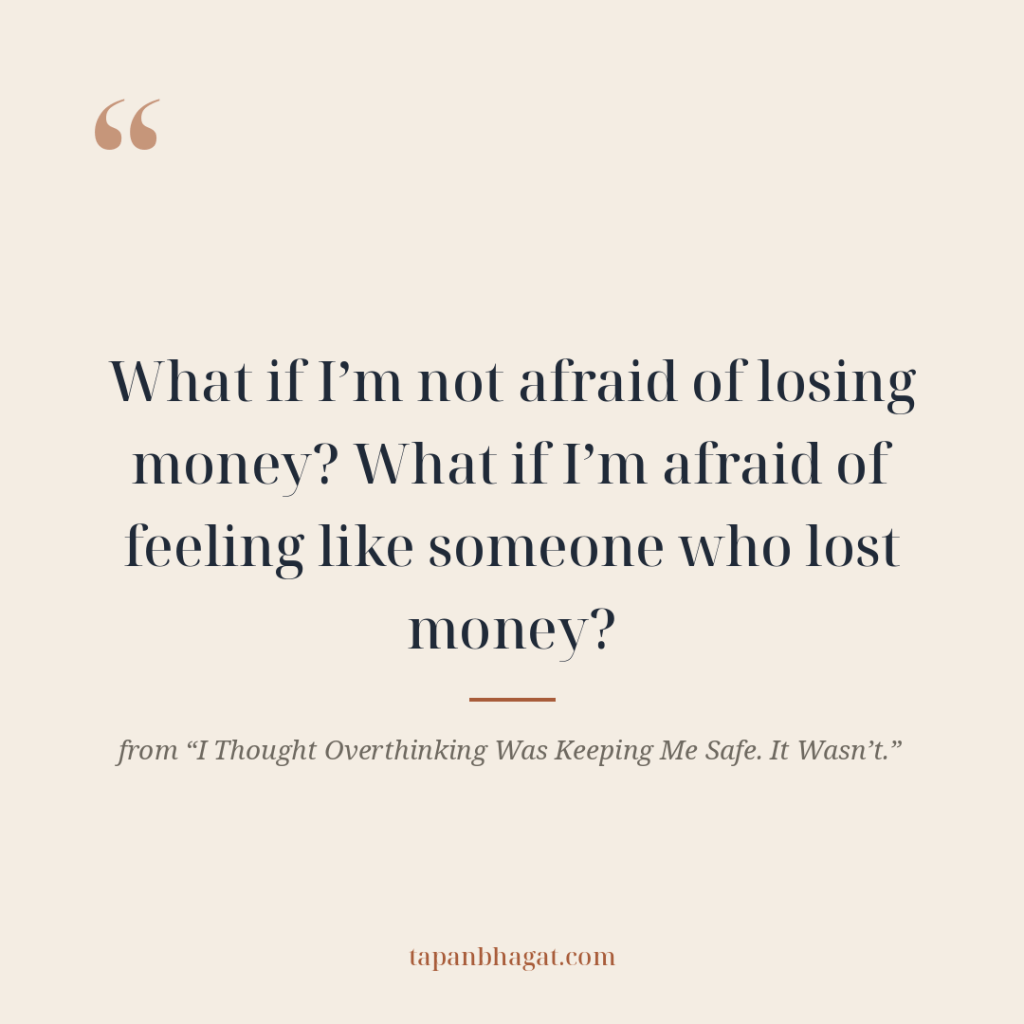
Then, in the middle of one of those 2 AM sessions, a different question floated up: What if I’m not afraid of losing money? What if I’m afraid of feeling like someone who lost money?
The moment I asked that, something shifted. The problem wasn’t the decision. The problem was that I didn’t trust myself to handle the feeling if the decision went wrong.
I was looking for safety in the perfect choice. But real safety doesn’t come from never failing. It comes from knowing that if I do fail, I won’t abandon myself. I’ll still be here, still standing, still able to say, “Okay, that happened. Now what’s next?”
That’s what self-trust actually is. Not confidence that I’ll always get it right. Confidence that I’ll support myself when I get it wrong.
Choosing Anyway
So I made the decision. Not because I had thought through every possibility, but because I had finally understood that thinking through every possibility was impossible.
I chose the option that aligned with what I valued: providing stability for my family, taking a calculated risk, and being honest about what I could afford to lose.
I also made a quiet promise to myself: whatever happened, I would not use it as evidence that I was foolish. I would use it as information. If it worked, good. If it didn’t, I would figure out the next step without turning the mistake into a character flaw.
The project is still ongoing. I don’t know how it will turn out. That part hasn’t changed. What’s changed is that I’m no longer rehearsing its failure every night.
What I Know Now
Overthinking promises certainty. It says, if you just think hard enough, you can find the perfect path. But certainty is a mirage — the world is too complex and too simple in the very same moment, the future too stubbornly unknown for that promise to ever actually pay out.
The only real safety I have is the relationship I build with myself. The slow, daily practice of saying: I will make a decision. I will do my best. And whatever happens, I will not turn against myself.
Maybe the question was never “How do I stop overthinking?” Maybe it’s “How do I start trusting myself enough to think less and live more?”
I’m still learning the answer. But I’ve noticed that when I trust myself, the thoughts quiet down on their own. They don’t need to be fought. They just lose their urgency.
I’m sleeping better these days. The 2 AM sessions have stopped. The room I used to disappear into for hours doesn’t pull me in the way it used to. I still visit it sometimes. But I know how to leave.
Because the safety I was looking for was never in the perfect decision.
It was in me, all along.


Leave a comment